
Technology
Application Modernization Services: The Case for Rebuilding With the User in Mind

There is a version of application modernization that technically succeeds and practically fails. The architecture gets upgraded. The infrastructure moves to the cloud. The deployment pipeline modernizes. And then the system ships, users open it for the first time, and the adoption numbers tell a different story than the project plan predicted. The interface is unfamiliar. Workflows that were muscle memory in the old system do not transfer. Complaints come in, workarounds multiply, and leadership begins asking why a multimillion-dollar modernization effort is producing results that look a lot like the problem it was meant to solve.
This failure mode is not rare. It is, in fact, the most common way that application modernization services fall short, and it is almost always preventable. The difference lies in whether user experience design services and UI design services were treated as core components of the program or whether they were left for later.
What Application Modernization Services Are Actually Solving
The starting point matters. Application modernization services exist because legacy systems eventually reach a ceiling. The ceiling looks different in every organization, but the shape of it is recognizable: development cycles that slow to a crawl because every change risks breaking something upstream; security vulnerabilities in frameworks that have not been actively maintained in years; integration limitations that prevent the business from adopting tools its competitors are already using; operational costs that scale poorly relative to the value the system delivers.
At BayOne, application modernization services address the root architecture, not just the surface symptoms. That means moving from monolithic structures to modular, service-oriented designs that can be developed, tested, and deployed independently. It means re-platforming to cloud infrastructure that scales with demand rather than requiring capacity to be manually provisioned. It means replacing brittle, custom-built integrations with API-first designs that connect to the broader ecosystem of tools the business depends on.
The technical work is genuinely complex and has to be planned carefully. What it cannot be is the only thing that gets planned carefully.
The Moment User Experience Design Services Become Critical
The moment application modernization services shift from a back-end program to a user-facing change is the moment user experience design services become critical. For some systems, that moment is at the database and integration layer and users see very little change in the interface. For most enterprise applications, modernization changes what is possible in the interface, which means the interface should change to reflect that.
User experience design services in a modernization context are not about giving the old system a fresh coat of paint. They are about asking, with real research and real user involvement, whether the workflows the original system encoded still reflect how people actually work. They are about surfacing the friction points that users have learned to live with but that no longer need to exist. They are about designing the new system around the behaviors and mental models of the people who will use it rather than around the constraints of the old one.
This is the kind of work that prevents modernization programs from producing technically modern systems that feel no better to use than what they replaced.
Where UI Design Services Make the Difference Visible
If user experience design services define how the system should work from the user’s perspective, UI design services determine how that logic is expressed on screen. This is the layer that users encounter directly and form impressions about immediately.
UI design services during a modernization program cover more than visual updates. They establish a coherent design system with defined components, spacing, typography, color, and interaction states. They create the consistency that makes a system feel intentional rather than assembled from independent decisions made by different teams over time. They produce documentation that developers can implement accurately without reinterpreting design intent at each screen.
When UI design services run in parallel with back-end development rather than after it, the interface is designed around the actual behavior of the new system rather than the assumed behavior. Output formats, loading states, error conditions, and data presentation patterns all reflect what the system can genuinely deliver. That alignment between design and implementation is what produces a launch experience that matches user expectations rather than managing them down.
The Phases of a Modernization Program That Works
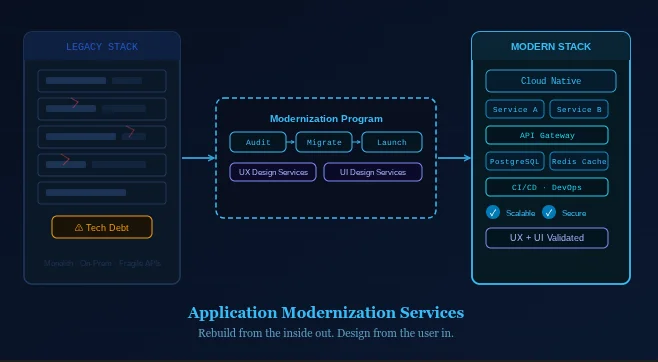
A well-run modernization engagement at BayOne is structured to keep technical and design work coordinated throughout, not sequenced. Here is what that looks like in practice:
- Discovery and architecture audit: Map all existing dependencies, integrations, data flows, and user-facing workflows. Identify what carries forward, what gets rebuilt, and what gets retired.
- User research: Interview and observe the actual users of the current system. Understand what they value, what frustrates them, and what workflows they have built around the system’s limitations.
- Architecture design: Define the target state, including infrastructure, service boundaries, data model, and API contracts. Establish the technical foundation for everything that follows.
- User experience design services: Design the new interaction model based on research findings. Produce journey maps, information architecture, wireframes, and interaction specifications that reflect both user needs and the new system’s capabilities.
- UI design services: Build the design system and component library. Design all screens within that system. Produce handoff documentation that allows development to implement consistently.
- Incremental migration: Move functionality in phases. Run old and new systems in parallel where necessary to reduce transition risk.
- Testing and validation: Conduct usability testing at prototype and staging stages. Resolve friction before users encounter it in production.
- Launch and monitoring: Deploy with observability tooling in place. Track adoption, performance, and user behavior from day one.
Why Sequencing Matters as Much as Scope
One of the most consequential decisions in a modernization program is when design work begins relative to technical development. Organizations that start user experience design services early, before architecture decisions are finalized, have the opportunity to let user research influence technical choices. Data that needs to surface in the interface affects how it is stored and served. Workflows that users depend on affect where service boundaries are drawn.
Organizations that bring in UI design services only after the back end is built often find that design decisions are constrained by technical choices that were made without user context. The interface becomes an accommodation rather than an expression of how the system was meant to work.
Getting this sequencing right is one of the clearest markers of an application modernization services partner that understands the full scope of the problem.
The Business Case for Getting Both Right
Modernization programs are significant investments. The ROI depends on adoption, and adoption depends on the experience being genuinely better for the people using it. A system that is architecturally modern but experientially unchanged delivers infrastructure benefits while leaving the user-facing value on the table.
Organizations that invest in application modernization services, user experience design services, and UI design services as a coordinated program consistently see faster adoption, lower training overhead, reduced support volume, and stronger satisfaction scores from both internal users and customers. Those outcomes are what turn a technical program into a business result.
Frequently Asked Questions
What do application modernization services include beyond migrating to the cloud?
Application modernization services cover the full scope of transitioning legacy systems to maintainable, scalable architectures. This includes decomposing monolithic applications into modular services, redesigning data models and APIs, replacing deprecated integrations, establishing CI/CD pipelines, and coordinating user experience design services and UI design services so the new system is as improved for users as it is for the teams maintaining it.
Why should user experience design services begin before technical development in a modernization project?
Starting user experience design services early allows research findings to influence technical decisions rather than be constrained by them. Workflows that matter to users affect how services are bounded and how data is structured. When design begins in parallel with architecture planning rather than after it, the resulting system is designed around actual user needs from the foundation up, not retrofitted to accommodate them after the build is done.
What is the risk of excluding UI design services from a modernization program?
Excluding UI design services typically produces a modernized back end with an interface that still reflects the old system’s limitations, visual inconsistencies across screens, and a user experience that fails to reflect what the new architecture actually makes possible. Users form impressions of a system within the first few interactions, and a poor initial experience significantly raises the cost of achieving adoption regardless of how technically capable the underlying system is.
How do you manage business continuity during application modernization?
BayOne structures modernization programs in phases that allow old and new systems to run in parallel during transition. Critical workflows are migrated incrementally with validation gates between phases rather than in a single cutover. This approach reduces the risk of disruption and gives users time to build confidence in the new system before the old one is retired, which also produces better feedback for the teams running user experience design services and UI design services iterations.
How is success measured in an application modernization engagement?
Success metrics span technical and user-facing dimensions. On the technical side: deployment frequency, error rates, system availability, and infrastructure cost. On the user side: task completion rates, time-on-task, support ticket volume, and satisfaction scores. BayOne defines these metrics before development begins so progress is measurable throughout the program rather than assessed only at launch.


Introduction to123safe67
In today’s digital landscape, our personal data is more vulnerable than ever. Every click, every transaction, and every interaction online carries the risk of falling into the wrong hands. As cyber threats become increasingly sophisticated, protecting your sensitive information has never been more critical. Enter 123safe67—a powerful solution designed to fortify your digital presence against a tide of cyber attacks.
Imagine having a virtual fortress that safeguards your personal data while allowing you to navigate the internet with confidence. With 123safe67 by your side, you’ll not only shield yourself from relentless hackers but also enjoy peace of mind in an age where privacy feels like a luxury. Let’s dive deeper into how this innovative platform can be your ultimate guardian in a world fraught with digital dangers.
The Growing Threat of Cyber Attacks
Cyber attacks are no longer just the stuff of movies. They have become a daily reality for individuals and businesses alike. The rise in digital connectivity has opened up countless doors, but it has also created vulnerabilities.
Hackers are constantly evolving. Their tactics range from phishing scams to sophisticated ransomware attacks that can cripple entire organizations overnight. Every click on a dubious link or download of an unverified file increases the risk of falling victim to these threats.
Data breaches occur with alarming frequency, exposing personal information at unprecedented levels. Even major corporations aren’t immune; high-profile incidents dominate news headlines, leaving consumers feeling anxious about their own security.
As our reliance on technology grows, so does our exposure to potential breaches. It’s crucial now more than ever to prioritize digital safety and seek robust solutions like 123safe67 before it’s too late.
How 123safe67 Can Protect Your Personal Data?
123safe67 employs advanced encryption technology to safeguard your personal data. This means that sensitive information is transformed into a secure format, making it unreadable to unauthorized users.
Moreover, 123safe67 utilizes multi-factor authentication. By requiring two or more verification methods before access is granted, this adds an extra layer of security against potential breaches.
Regular updates are another key feature. The platform continuously adapts to emerging cyber threats, ensuring your data remains protected in an evolving landscape.
Additionally, user-friendly dashboards allow for easy monitoring of account activity. You can quickly spot anything unusual and take action if necessary.
With 123safe67, you gain peace of mind knowing that robust measures are in place for your digital safety. Your personal data deserves the best protection possible, and this service delivers just that.
Features and Benefits of 123safe67
123safe67 offers a robust suite of features designed to keep your personal data secure. Its advanced encryption technology ensures that even the most sensitive information remains confidential.
User-friendly interfaces make navigation seamless, allowing individuals and businesses alike to manage their security effortlessly. With real-time monitoring, potential threats are detected instantly, giving users peace of mind.
The multi-factor authentication adds an extra layer of protection. This means unauthorized access is significantly minimized.
Additionally, 123safe67 provides regular updates that adapt to evolving cyber threats. Users benefit from cutting-edge security without any hassle.
Another notable feature is its compatibility across various devices. Whether you’re using a smartphone or desktop, 123safe67 integrates smoothly into your daily routine.
Exceptional customer support means assistance is just a click away when needed. Prioritizing user experience while enhancing safety truly sets 123safe67 apart in the digital landscape.
User Testimonials
Users of 123safe67 have shared their experiences, shedding light on its effectiveness. Many describe it as a game-changer for personal data security.
One user noted the ease of setup. They appreciated how quickly they could start protecting their sensitive information without any technical expertise.
Another testimonial highlighted the peace of mind that comes with using 123safe67. With cyber threats lurking everywhere, knowing that their data is secure makes all the difference.
Several users also praised customer support. Quick responses and helpful guidance added to their overall satisfaction with the service.
These authentic voices paint a picture of trust and reliability around 123safe67, showcasing its role in safeguarding personal data amidst rising cyber risks.
Comparison with Other Digital Security Solutions
When comparing 123safe67 to other digital security solutions, several aspects stand out. Many traditional antivirus programs focus primarily on malware detection. However, they often overlook the broader spectrum of cyber threats.
123safe67 integrates advanced encryption technology that secures personal data in transit and at rest. Unlike many competitors, it offers real-time monitoring for suspicious activities across all devices.
User-friendly interfaces are a hallmark of 123safe67. While some security platforms can be cumbersome and confusing, this service prioritizes simplicity without sacrificing functionality.
Moreover, customer support is vital when facing cyber issues. 123safe67 provides responsive assistance tailored to individual needs, which sets it apart from less accessible options available on the market.
Pricing structures also vary widely among providers. With flexible plans designed for different users—from individuals to businesses—123safe67 ensures that high-level protection remains accessible for everyone.
Steps to Get Started with 123safe67
Getting started with 123safe67 is a straightforward process. First, visit the official website and create your account. You’ll need to provide basic information like your email and a secure password.
After signing up, install the software on your chosen hardware.The interface is user-friendly, ensuring easy navigation for both tech-savvy individuals and beginners.
After installation, log in to your account. Follow the prompts to set up two-factor authentication for added security.
Next, explore the dashboard where you can customize settings according to your needs. Prioritize what data you want protected most—financial information or personal documents?
Take advantage of tutorials available within the app. They guide you through maximizing features tailored for safeguarding your data effectively. Embrace this digital fortress with confidence!
Tips for Maintaining Digital Security Beyond 123safe67
Maintaining digital security goes beyond just using a tool like 123safe67. Frequently refresh your login codes and apply distinct sequences for various profiles. A strong password is your first line of defense.
Enable two-factor authentication wherever possible. This adds an extra layer of protection, making it harder for unauthorized users to access your information.
Stay vigilant against phishing scams. Always verify the source before clicking on links or providing sensitive data. Cybercriminals constantly evolve their tactics, so awareness is key.
Keep your devices updated with the latest software patches and security updates. These often address vulnerabilities that hackers exploit.
Back up important files regularly. Cloud services or external hard drives can safeguard critical data in case of an attack or system failure. Consistency in these practices will enhance your overall digital security strategy significantly.
Conclusion
As we navigate an increasingly digital world, ensuring the safety of our personal information is more crucial than ever. 123safe67 stands out as a reliable solution for safeguarding your data from emerging cyber threats. With its advanced features and user-friendly interface, it provides peace of mind in an era where security breaches are all too common.
By leveraging the strengths of 123safe67, individuals can take proactive steps to protect their sensitive data. Whether you’re concerned about identity theft or simply want to keep your online presence secure, this platform offers a comprehensive approach to digital safety.
Moreover, user testimonials highlight not just effectiveness but also satisfaction with ease-of-use and customer support. Compared with other solutions available today, 123safe67 excels in delivering robust protection without overwhelming users with complexity.
Getting started is straightforward—sign up and begin protecting your data within minutes. And remember that while tools like 123safe67 provide essential layers of security, maintaining good digital hygiene remains vital in today’s landscape.
Investing time into understanding how to enhance your online security further ensures that you stay one step ahead against potential threats. Embrace these measures today; after all, it’s better to be safe than sorry when it comes to protecting what matters most: your personal information.
Let me ask you something. How many times have you watched a 45-minute YouTube tutorial, only to realize you need to scribble down every key point? Or maybe you’re a content creator who wants to repurpose a brilliant interview into a blog post—but the thought of manual transcription makes your wrist ache.
You’re not alone. Millions of people face this exact frustration every single day. And here’s the good news: you don’t need to pay a fortune or spend hours typing anymore. A YouTube transcript generator can do the heavy lifting for you.
In this guide, I’ll walk you through exactly how these tools work, why they matter more than ever in 2026, and how you can start using one today—no credit card required.
Why You Need a Free YouTube Transcript Generator Right Now
Let’s be honest. Video is king. But text still rules when it comes to:
- Searchability – Google can’t “watch” your video, but it can index a transcript.
- Accessibility – Not everyone can turn up the volume. Captions and transcripts open your content to a wider audience.
- Repurposing – One video can become a blog post, email newsletter, social media thread, or even an ebook chapter.
A reliable free YouTube transcript generator bridges the gap between the video content people love and the written format they need. Whether you’re a student trying to capture lecture notes, a marketer building a content library, or a podcaster expanding into written content, the right tool saves you hours of tedious work.
And here’s the kicker: the best tools don’t just spit out raw text. They format it, timestamp it, and make it actually usable.
How a Free YouTube Transcript Generator Actually Works
You might be wondering: Is this going to be complicated? Not at all.
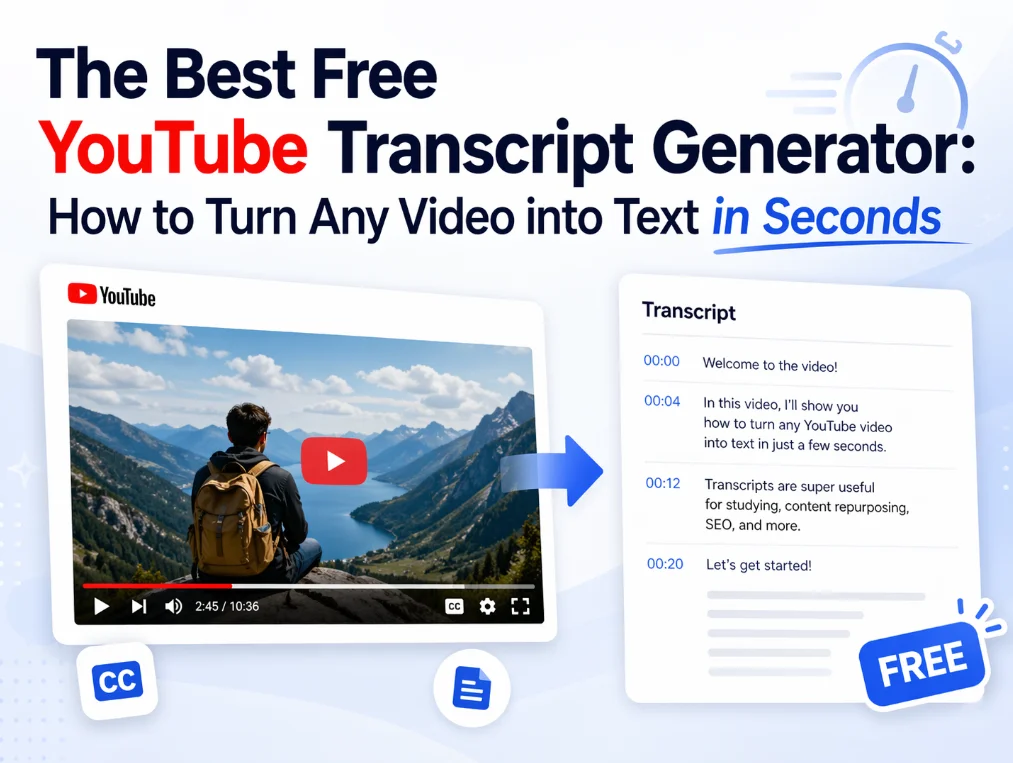
Most modern transcript generators follow a simple three-step process:
- Paste the YouTube URL – No downloads. No extensions. Just copy and paste.
- AI processes the audio – Advanced speech recognition converts spoken words into written text with surprising accuracy.
- Download or edit – Grab your transcript as a .txt, .srt, or even a formatted document.
The technology behind this has improved dramatically. We’re no longer stuck with the robotic, error-filled captions of five years ago. Today’s AI understands context, accents, and even industry jargon.
Real-World Ways to Use a Free YouTube Transcript Generator
Theory is nice. But let’s talk about how real people are using these tools to save time and grow their work.
1. The Overwhelmed Student
Meet Jake. He’s a college junior taking an online data science course. His professor uploads two-hour lecture videos every week. Jake used to pause, rewind, and type notes for hours. Now? He runs each video through a free YouTube transcript generator, gets a clean text file, and highlights the key concepts in minutes. His study time dropped by 70%. His grades? They went up.
2. The Solo Content Creator
Sarah runs a small YouTube channel about sustainable living. She interviews experts, reviews products, and shares tips. Every month, she turns her three best videos into blog posts to boost her SEO. Before, she hired a freelancer for $50 per video. Now she uses a free YouTube transcript generator to create the first draft, spends 15 minutes editing for flow, and publishes. Her website traffic has doubled in six months.
3. The Remote Team Lead
Marcus manages a distributed team across three time zones. His company records all-hands meetings and training sessions on a private YouTube channel. Not everyone can attend live, and watching full recordings is inefficient. Marcus generates transcripts for every meeting, uploads them to the team wiki, and lets people search for exactly what they need. Onboarding new hires? It used to take a week. Now it takes two days.
What to Look for in a Free YouTube Transcript Generator
Not all tools are created equal. Before you commit, check for these features:
- No sign-up required – The best tools respect your time (and your inbox).
- High accuracy – Look for AI that handles multiple speakers and background noise.
- Timestamped output – Essential if you need to reference specific moments.
- Multiple formats – .TXT for reading, .SRT for subtitles, .DOCX for editing.
- Language support – Because great content exists in every language.
A truly valuable free YouTube transcript generator won’t slap a paywall on you after the first 30 seconds of audio. It will give you a complete, usable result—no strings attached.
Common Mistakes to Avoid
Even the best tool won’t help if you use it wrong. Here are three pitfalls I see all the time:
Relying on raw output without editing. AI is impressive, but it’s not perfect. Always skim for errors, especially with names, technical terms, and numbers.
Ignoring formatting. A giant wall of text is hard to read. Break your transcript into paragraphs. Add speaker labels if there are multiple voices.
Forgetting about SEO. If you’re publishing the transcript online, treat it like any other piece of content. Add a compelling headline, internal links, and a brief introduction. A free YouTube transcript generator gives you the foundation—you still need to build the house.
Final Thought: Your Content Deserves to Be Found
Video is powerful. But in a world drowning in content, the creators who make their work discoverable are the ones who win. Saveto AI free YouTube transcript generator isn’t just a convenience tool. It’s a strategy. It turns passive viewers into active readers. It makes your expertise searchable, shareable, and scalable.
So here’s my challenge to you: pick one video you’ve created or watched recently. Run it through a free YouTube transcript generator today. See what happens when your words break free from the screen and start working for you 24/7.
The best part? It won’t cost you a dime. But the time you’ll save? That’s priceless.

Key Takeaways
- ✅ езиково значение is not fixed — it shifts with context, culture, and usage.
- ✅ There are at least 4 types of meaning: denotative, connotative, pragmatic, and cognitive. ✅ Полисемия and омонимия are the most common sources of linguistic ambiguity.
- ✅ Modern linguistics uses corpus data and AI to analyze meaning at scale.
- ✅ Understanding езиково значение is critical for translation, education, and communication.
Why Linguistic Meaning Is Far More Complex Than You Think
Most people assume a word equals a meaning. That is wrong. езиково значение — linguistic meaning — is a multi-layered phenomenon. It depends on the speaker, the listener, the context, and even the tone of voice. Linguists have studied this for centuries and still find new dimensions to explore.
A single езикова единица (linguistic unit) does not exist in isolation. It lives inside sentences, texts, and conversations. When you say “bank,” do you mean a financial institution or a riverbank? The answer depends entirely on контекстуална употреба — contextual usage. This is exactly what makes language so rich and so difficult for machine translation systems.
Ferdinand de Saussure was the first to show us that the linguistic sign consists of two inseparable parts: the signifier (form) and the signified (concept). This idea permanently changed linguistics. Today it sits at the foundation of every modern theory about семантично поле — the semantic field.
Understanding linguistic meaning is not just an academic exercise. It is a practical skill. A skilled translator, a teacher, a journalist — all of them work directly with the multi-layered nature of meaning every single day.
The Four Pillars of езиково значение
Лексикално значение is the most basic layer. It is what you find in a dictionary — the direct, literal definition. The word “water” means a transparent liquid, H₂O. Simple and clear. But language rarely stops there.
Денотативно значение is the objective, referential meaning. It points to a real object or phenomenon in the world. Scientists and lawyers love denotation — it is precise, indisputable, and documentable. ISO standards for technical documents demand exactly this kind of denotative precision.
Конотативно значение is where things get interesting. “Fox” denotes an animal. But it connotes cleverness, cunning, and intelligence. These additional layers come from culture, history, and shared experience. Конотативно значение varies between communities — even between neighboring cities.
Прагматично значение is meaning in action. “Can you open the window?” is not a question about physical ability — it is a request. Pragmatics studies how people use language to achieve real goals. Austin and Searle’s Speech Act Theory is foundational here. Without прагматично значение, we cannot understand irony, hints, or a polite refusal.
Semantic Comparison Table: The Four Types of Meaning
| Type of Meaning | Definition | Example | Field of Application |
|---|---|---|---|
| Лексикално | Dictionary, base meaning | “Rose” = a flower | Lexicography, education |
| Денотативно | Objective reference | “Rose” = Rosa genus | Science, law, standards |
| Конотативно | Subjective associations | “Rose” = love, beauty | Literature, advertising |
| Прагматично | Meaning in context | “Rose is here” = an announcement | Communication, diplomacy |
| Cognitive | Mental model | Rose as a prototype of a flower | Psycholinguistics, A |
Полисемия, Омонимия, and Semantic Shift
Полисемия is one of the richest phenomena in language. One word, many related meanings. “Head” can mean an anatomical part, a leader, or a chapter of a book. All these meanings are connected — they trace back to the base image of “something on top, something leading.” WordNet, the large lexical database from Princeton, documents thousands of such polysemic networks.
Омонимия is different. Here the shared form is a coincidence — the meanings share no historical connection. The words sound alike and are spelled alike, but they come from completely different roots. Homonyms are traps for translators and a nightmare for дискурсен анализ — discourse analysis systems.
Семантична промяна shows how language breathes over time. Words die, are born, and change meanings. “Villain” in English once simply meant “peasant.” Today it means an evil person. These changes are not random. They follow social, historical, and psychological patterns that linguists can map and predict.
Cognitive linguistics — especially Rosch’s Prototype Theory — explains why we accept certain meanings as “more central” than others. A sparrow feels like “more of a bird” than a penguin, even though both are birds. These когнитивна лингвистика structures determine how we categorize and understand the language we use daily.
Expert Perspective: How Linguists Measure Meaning Today
Modern linguistics does not rely on intuition alone. It uses data. Corpus linguistics analyzes millions of texts to uncover real usage patterns. Tools like Sketch Engine and the British National Corpus (BNC) show how frequently a word appears, which words it collocates with, and how its meaning has shifted over decades.
Семиотика — the science of signs — contributes a broader framework. It studies not only language but all sign systems: gestures, images, music. Peirce and Saussure represent the two dominant schools. For content strategists and SEO professionals, understanding semiotics means better understanding of езикова норма and how it forms in digital spaces.
AI and machine learning have completely transformed how we work with linguistic meaning. Models like BERT and GPT use vector representations — words are converted into numbers in a high-dimensional space. Words that are close in meaning sit close together in that space. This is exactly how Google understands your search query — not literally, but semantically. Frege’s Compositionality Principle is partially realized inside these modern models.
Синонимия and антонимия are practical tools inside these systems. Synonym chains (e.g., fast/rapid/instant) expand semantic coverage. Antonym pairs (cold/hot) structure knowledge. Lexical databases like WordNet encode these relationships formally so that machines can process and reason about them.
Implementation Roadmap: Apply Linguistic Meaning in Real Work
Step 1 — Analyze context before usage. Before writing any text, ask: who is the audience? What connotations does this word carry for them? The морфологична структура of a word gives clues — prefixes and suffixes signal layers of meaning.
Step 2 — Use semantic fields deliberately. Group words around a central concept. If you are writing about “water,” the semantic field includes: river, moisture, rain, thirst, purification. These words are not just synonyms — they build a conceptual network that strengthens your content.
Step 3 — Check for полисемия and омонимия. Especially critical in translation or technical writing. Ambiguous terms must be clearly defined. ISO standards for terminology (ISO 704) explicitly require unambiguous definitions in specialized texts.
Step 4 — Test pragmatic effectiveness. Does the text achieve the intended effect? Does the reader understand the intention? Feedback is the only real test of прагматично значение working in practice.
Step 5 — Update your vocabulary regularly. Language changes. Семантична промяна is a constant process. Words that sounded neutral ten years ago may today carry heavy new connotations that shift your entire message.
Future Outlook 2026: Where Linguistic Meaning Is Heading
Artificial intelligence will continue to transform how we work with езиково значение. Multilingual models already translate not just words but context, tone, and cultural weight. Technologies like Google’s semantic search will become increasingly precise at capturing the intent behind a query rather than just matching keywords.
Когнитивна лингвистика will merge with neuroscience. Brain research using fMRI shows how different meanings activate different brain regions. This will reshape education — students will learn not just word forms but entire conceptual networks and how they connect.
For businesses, езикова норма will be regulated more strictly. The EU is already advancing its AI Act, and linguistic precision in legal and medical documents will become mandatory. Understanding лексикално значение at a deep level will become a genuine competitive advantage — for companies, professionals, and AI systems alike.
Синтактична функция and semantics will be studied together, not in isolation. Future grammars will be cognitive-functional — they will explain why language works a certain way, not just how. Linguistics students, translators, and SEO professionals will all need to think semantically at every level of their work.
FAQs
Q: What is the difference between denotative and connotative meaning?
Denotative meaning is the objective, dictionary definition of a word. Connotative meaning adds subjective associations — emotional, cultural, and historical. “Snake” denotes a reptile, but in many cultures it connotes betrayal and deception.
Q: How does context affect езиково значение?
Context is everything. The same word can mean opposite things in different situations. “Brilliant!” said sincerely is a compliment. Said sarcastically, it is criticism. Pragmatics studies exactly these situational shifts in meaning.
Q: What is полисемия and why does it matter?
Полисемия is when one word carries multiple related meanings. It matters because language is economical — instead of creating new words for every nuanced meaning, we expand existing ones. Understanding it is essential for translation, NLP, and education.
Q: How do AI systems process езиково значение?
Modern AI models use vector representations — words are encoded as numbers in a high-dimensional space. Words that are close in meaning cluster together in that space. Models are trained on massive corpora and capture semantic relationships statistically, not through rigid rules.
Q: Why does езиково значение change over time?
Language reflects society. Social changes, technology, and contact with other languages all influence meaning. “Mouse” once meant only a small animal. Today it also means a computer device. Semantic change is natural and continuous.

How Cp As Help Businesses Navigate Complex Tax Laws

How Implant Dentistry Restores Both Function And Aesthetics

Snowhiter: A Journey Into the Enchanting Heart of Winter’s Beauty

Trinou: Mobility, Magazines, and the Weight of a Spiteful Household

Messeregge: The Masterful Synthesis of Ancestral Craft and Modern Utility
-

 General4 weeks ago
What Is Felixing? The Truth Behind a Junk Keyword
-

 Health8 months ago
Lufanest: Effective Local Anesthesia with Fewer Risks
-

 Entertainment1 month ago
هنتاوي.com: Your Gateway to Arabic Anime Content
-

 General9 months ago
bardoek: The Artistic Heritage Inspiring Modern Creative Trends
-

 General7 months ago
Discover Anonib AZN: An Anonymous Asian Forum
-

 Fashion3 weeks ago
Fashionisk .com Explained: A Closer Look Before You Click
-
 General4 weeks ago
What Is Euroyungs Com? What I Found After Digging In
-

 Lifestyle9 months ago
Mariano Iduba: A Visionary Leader in Global Digital Growth