
Business
What is Lead Generation In Marketing?


In marketing, lead generation fuels the sales engines.
Leads are people, business and organizations that are the best fit for a selling approach. And marketing is the process that helps to find out these leads.
This blog will discuss what is lead from marketing’s perspective and also discuss how leads are generated through marketing efforts for a business.
What Does Lead Actually Mean?
A lead is a business, person or entity who has shown interest for your business or offerings. It basically represents a potential buyer who has taken some noticeable steps that shows they have interest in you.
However, this interest can vary from business-to-business or person-to-person. Some leads may be just exploring a solution, while others are actively comparing vendors for purchase. Treating them equally creates a poor contact list, overall hurting the business.
Overall, a lead is like fuel for a sales engine that eventually runs the whole operation.
Here are some different 3 core types of leads:
1. Marketing Qualified Leads (MQLs)
Marketing Qualified Leads are prospects who have engaged with your marketing efforts but are not still ready for sales. They may have downloaded any resource, signed up for emails or regularly viewed your content. These actions clearly indicate curiosity and problem awareness, not urgency.
MQLs need nurturing and building trust, not just aggressive salesy outreach. When these are handled properly, their conversion rate increases dramatically.
2. Sales Qualified Leads (SQLs)
Sales Qualified Leads are contacts that have shown a clear intent to evaluate or purchase what you sell. Common indicators for SQLs include requesting for pricing, booking a demo or simply asking to speak with sales representatives.
Here, timing matters more than volume. SQLs expect relevance, context, and speed.
3. Product Qualified Leads (PQLs)
Product qualified leads (PQLs) are prospects who’ve already tested your value in the real world either by demo testing or from previous purchase. They’ve used the product, hit limits, or changed behavior inside it.
Lead Generation And Marketing
Marketing and lead generation are the two core business aspects that fuel sales and ensure constant revenue generation. They are highly related and drive each other’s tactics.
In simple words, marketing works to increase market share and increase brand signature. Lead generation uses this and makes a list of prospects who are ideal fit for selling.
Marketing creates the base by building awareness among this potential group, then nurturing them to become an actual lead. Lead then uses marketing insights to make a strategy, then pitch to sell.
Why Lead Generation Is the Lifeblood of Modern Business and Marketing
Lead generation matters because it creates consistent, controllable demand instead of unpredictable sales outcomes. Without it, growth depends on timing, referrals, or short-term wins that are difficult to scale.
One of the biggest advantages of lead pipelines is predictable revenue. A structured lead generation system reduces uncertain business fluctuations. When lead flow is steady, forecasting becomes more reliable and decisions around hiring, budgeting and expansion carry less risk.
Lead generation also allows businesses to build trust before the sales conversation begins. Buyers rarely purchase the first time they encounter a brand.
Finally, lead generation improves efficiency. Compared to conventional, mass-targeted advertising, it focuses resources on people already expressing interest. This results in lower acquisition costs, higher close rates, and a stronger alignment between marketing and sales.
The Lead Generation Process: Step-by-Step
Lead generation follows a simple flow: attract attention, provide direction, offer value and capture intent. What complicates it is execution. Each step depends on the previous one doing its job properly.
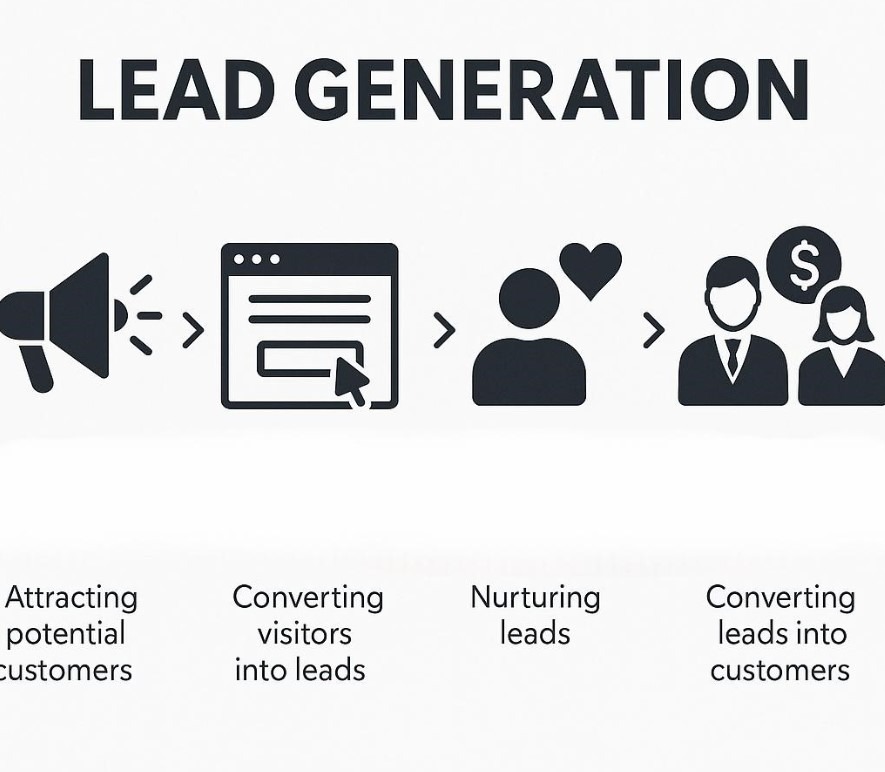
Step 1 – Discovery (The Visitor)
Discovery starts when someone comes across your brand while looking for information—not when you push a message in front of them. This usually happens through search results, blog posts, social feeds or shared resources.
What matters here is matching prospects’ demands with your solutions. Content that ranks but doesn’t match problem related search intent won’t convert that much.
Someone searching for an explanation or answer wants a clear response or solution, not a sales pitch. Someone comparing options expects specific information. If the content misses that expectation, the stage ends without any result.
Step 2 – The Call-to-Action (CTA)
A CTA tells visitors to make an immediate action and explains its outcomes.
Unclear CTAs bring less leads because they ask people to guess the outcome. Clear CTAs work effectively because they set expectations clearly. One page should point to one action. When pages offer too many choices, most users choose none.
Step 3 – The Landing Page
A landing page is specifically designed for one outcome: conversion. When a contact visits a marketing content, they at a point are sent to landing pages. These pages have explanations of offers, products or services.
Unlike a homepage, it doesn’t try to explain everything about the business. Rather it focuses on what is to offer. It makes contacts to make an action like book a demo or purchasing offerings.
Step 4 – The Lead Magnet (The Offer)
People don’t share their contact details on their own. They do it because the offer feels important and useful.
Good lead magnets reduce friction and eliminate suspicion. Checklists are time-saving, templates are error-reducing, and the webinars provide a real answer to a real situation. When offers solve real world problems, conversion rate increases.
Step 5 – The Form
Forms only get the highest intended leads. Even short forms take a bit of time and effort to complete. When a contact willingly fills a form it indicates that all funnel stages have achieved a good outcome.
Overall these forms provide key leads. These leads normally have a bigger average deal size.
Inbound vs. Outbound Lead Generation
Lead generation mainly happens in two ways; first one is outbound where you reach to your potential leads for qualification. The second one happens when potential leads come to you. It happens when they find your marketing content and find it engaging and beneficial.
Inbound Lead Generation
Inbound lead generations make leads come to you. It happens when SEO, content marketing, and social lets prospects find you while they’re already thinking about a problem.
This usually results in warmer conversations because trust starts forming before any direct outreach happens.
Inbound marketing and lead generation takes a longer time to get results. Although it happens slowly, it provides a better average deal size. Inbound marketing is effective in long term relationship building. With a proper channel, it gets a significant ROI.
Outbound Lead Generation
In outbound lead generation, you reach your prospects before they contact you or someone else.
First you identify segmented audiences or contacts and reach out directly through cold email, LinkedIn messages, or phone calls. Then the qualification process starts.
With the requirements from the employer, you qualify them as per appointment setting leads, sales qualified leads or simply score them as their position.
Top Lead Generation Strategies for 2026 From a Marketing Point of View
Lead generation in 2026 is competitive yet precise at the same time. Different marketing components, tech and AI have made lead generation more accurate. But as these are available for all, generating leads becomes highly competitive as well.
Timing, precision and best output is needed for successfully nurturing leads and shifting them through the sales funnel.
Content Marketing & SEO
Contents that have actual search volumes and intent performs best when it answers real buying related questions. For SEO base marketing contents, search intent and volume is needed for better output.
Websites and content that explain how something works, what the trade-offs are, or how to choose between options attract more prospects who are deeply evaluating solutions. This type of audience converts more because their intent already exists.
On the other hand, ranking helps with visibility, but relevant resources and content materials determine real outcomes. If the content doesn’t eliminate confusion or guide a decision, organic traffic alone won’t turn into leads.
Social Media Marketing
It uses social media platforms to nurture contacts through a marketing funnel. In B2B marketing,
LinkedIn provides a huge opportunity to generate leads and nurture them too.
It happens because decision-makers consider performance, growth, and risk before making any action. And LinkedIn is a professional site that creates a wide spectrum to capture leads from specific B2B buying committees. .
For B2C, all types of social media like META, YouTube, Ticktok play a crucial role to find leads through engagement.
Email Marketing
Email marketing uses email engagement to find out potential leads. It takes time to deliver the outcome, but still does. When integrated with other channels, email provides better response.
Its role isn’t to force any urgency rather to maintain presence while leads take time to decide. Most buyers don’t convert after the very first interaction. Email keeps the conversation flow without any pressure.
Conclusion
Lead generation turns marketing efforts into real sales opportunities. It helps businesses identify the right prospects, understand their intent level and guide them through a structured buying journey.
When done consistently with perfection, it reduces uncertainty, improves efficiency and creates a predictable flow of demand that supports sustainable business growth.

The modern workplace moves at a speed that can leave even the most prepared human resources departments scrambling. Project deadlines shift, seasonal rushes appear without warning, and key team members occasionally need extended leave. For many employers businesses, the immediate reaction is to rush through a permanent hire process.
However, this approach frequently leads to costly mistakes and missed opportunities. A smarter strategy involves partnering with specialists who focus on workforce solutions. Experts like QuickPro Jobs are helping connect employers and job seekers, keeping operations smooth without the long-term commitment. This collaboration has shifted from a nice-to-have option to a strategic necessity for companies that want to stay agile.
The Reality of Fluctuating Workloads
Business volume rarely follows a straight line upward. Most companies experience peaks and valleys that create staffing challenges throughout the fiscal year. A retailer might need triple the staff during holiday months, while a tax firm requires an army of accountants from January through April. Permanent staff often burn out when asked to handle these surges alone. Workforce partners maintain a ready pool of pre-screened candidates who can step in immediately when demand spikes. This arrangement allows companies to scale their teams up or down with zero awkwardness. The result is a workforce that matches revenue generation perfectly without excess payroll drag during slower periods.
Access to a Broader Talent Pool
Finding qualified candidates requires more than posting a job description on a popular website. Staffing agencies invest substantial resources in recruiting, screening, and maintaining relationships with workers across multiple industries. These providers understand where specific skill sets live and how to attract them. They tap into networks that include recent graduates, seasoned professionals seeking flexible arrangements, and experts between permanent roles. Employers gain exposure to individuals they would never encounter through traditional job postings. This wider net often uncovers hidden gems who bring fresh perspectives and specialized knowledge to temporary assignments. The relationship frequently leads to permanent placements after both sides confirm a good fit.
Reduction of Administrative Burden
Bringing on a new worker involves a mountain of paperwork and compliance requirements. Tax forms, background checks, skills verification, and orientation materials consume hours that managers could spend on core business activities. Workforce solution providers like QuickPro Jobs are helping connect employers and job seekers while providing administrative tasks as part of their service package. They manage payroll, benefits, and workers’ compensation insurance for the temporary staff they supply. This arrangement protects the client company from many of the legal risks associated with hiring.
Cost Control and Budget Predictability
Employment costs extend far beyond an hourly wage or annual salary. Benefits contributions, payroll taxes, training time, and unemployment insurance add significant expense to every permanent employee. Temporary workers through staffing partners appear as a predictable line item on invoices rather than variable overhead. This structure simplifies budgeting and protects against surprise expenses. Companies pay only for the hours worked, with no obligation for paid time off or holiday pay.
Test Driving Potential Permanent Hires
The traditional hiring process involves interviews, reference checks, and educated guesses about cultural fit. These methods leave plenty of room for error that leads to expensive turnover. Temporary assignments create an extended audition period where both parties evaluate the working relationship. Employers observe actual job performance, attendance patterns, and team dynamics before making permanent offers. Workers also assess whether the company culture and daily responsibilities match their expectations. This trial period dramatically improves retention rates for conversions to permanent status.
The relationship between employers and workforce solution providers continues to deepen as business complexity increases. Companies that embrace this partnership gain advantages in speed, cost management, and talent quality that competitors cannot easily replicate. Temporary talent fills immediate needs while opening doors to long-term staffing strategies that adapt to changing conditions.

Introduction to Yourassistantlive com
In today’s fast-paced digital landscape, businesses are constantly searching for tools that can streamline operations and enhance productivity. Enter Yourassistantlive com—a transformative platform designed to be the central hub for all your business needs. Whether you’re a solopreneur or part of a growing team, this innovative solution promises to simplify workflows and foster growth like never before. Imagine having everything you need at your fingertips: task management, communication tools, analytics, and more—all in one place. Curious about how Yourassistantlive com can revolutionize your daily operations? Let’s dive into its features and benefits that make it an essential resource for any business owner looking to thrive in today’s competitive environment.
Features and Benefits of Yourassistantlive com
Yourassistantlive com is packed with features designed to streamline your workflow. Its intuitive interface allows users to navigate effortlessly. Whether you’re managing tasks or scheduling appointments, everything is just a click away.
Collaboration tools enhance team productivity. Real-time updates ensure everyone is on the same page, minimizing miscommunication and delays. You can easily assign tasks and track progress in one unified platform.
Automation capabilities save time by simplifying repetitive processes. Set reminders for important deadlines or automate responses to common inquiries, freeing up valuable resources for strategic growth.
The analytics dashboard provides insights into performance metrics at a glance. This data helps businesses make informed decisions based on real-time feedback, ultimately driving efficiency and success.
Additionally, seamless integration with popular applications means you don’t have to change your entire system. Yourassistantlive com complements existing workflows rather than complicating them.
How Yourassistantlive com can Boost Productivity?
Yourassistantlive com streamlines daily tasks, allowing users to focus on what truly matters. By consolidating various tools into one platform, it reduces the time spent switching between applications. This seamless integration enhances workflow efficiency.
Automation features play a key role in boosting productivity. Routine tasks can be automated, freeing up valuable time for more strategic activities. Users can set reminders and deadlines that ensure no task falls through the cracks.
Collaboration is made easy with Yourassistantlive com’s built-in communication tools. Teams can share updates and files instantly, fostering an environment of transparency and cooperation. When everyone is aligned, projects progress faster.
The analytics provided by this platform offer insights into performance metrics as well. Understanding where time is spent helps identify areas for improvement, driving further productivity gains over time.
Success Stories of Businesses using Yourassistantlive com
Many businesses have transformed their operations with Yourassistantlive com. A small marketing agency saw a 40% increase in client engagement after integrating the platform into their workflow. They streamlined communication and project management, allowing for smoother collaboration.
A local e-commerce store reported that using Yourassistantlive com helped reduce response times by half. Customers appreciated the quick replies, leading to higher satisfaction rates and repeat purchases.
Another success story comes from a nonprofit organization that utilized Yourassistantlive com to coordinate events more efficiently. By managing volunteer schedules and donations through one unified hub, they were able to focus on their mission rather than logistics.
These examples illustrate how diverse organizations can leverage the features of Yourassistantlive com to achieve significant growth and efficiency in their operations. The adaptability of this platform makes it invaluable across industries, helping them meet specific needs effectively.
The Importance of a Unified Hub for Small Business Owners
Small business owners often juggle numerous tasks and responsibilities. This can lead to chaos without a structured system in place. A unified hub like Yourassistantlive com streamlines operations, making it easier to manage daily activities.
Having everything in one location reduces the time spent switching between different tools. Decreased administrative strain translates into more dedicated time for high-level business development.
Collaboration becomes seamless when teams can access shared resources effortlessly. Communication improves, fostering creativity and innovation among team members.
Moreover, data analysis is simplified within a centralized platform. Small businesses gain valuable insights that drive decision-making processes effectively.
This kind of organization not only enhances productivity but also instills confidence in small business owners as they navigate challenges with clarity and precision.
How to Get Started with Yourassistantlive com?
Beginning your journey with Yourassistantlive com is designed to be completely hassle-free. First, visit their website to explore the various services offered. You’ll find a user-friendly interface that makes navigation easy.
Next, create an account. Fill in your details and choose a plan that best suits your business needs. There are various options tailored for different scales of operation.
Once registered, take advantage of the onboarding resources available on the platform. These include tutorials and guides designed to help you maximize your use of the features.
Integrate Yourassistantlive com with other tools you currently use to streamline operations further. This integration ensures all aspects of your workflow remain connected.
Start utilizing its productivity features daily—set tasks, track progress, and engage with team members seamlessly as you grow your business efficiently.
Conclusion: Empower Your Business with Yourassistantlive com?
Empowering your business is all about making the right choices. Yourassistantlive com offers a unique platform that combines multiple tools into one cohesive hub, streamlining processes and enhancing productivity for small business owners. By adopting this integrated solution, you not only save time but also reduce stress while managing various aspects of your operations.
The user-friendly interface allows teams to collaborate seamlessly, ensuring everyone stays on the same page. Plus, with an array of features tailored to meet specific needs, your assistant live com adapts as your business evolves.
Success stories abound from businesses that have harnessed these capabilities and watched their growth soar. Their experiences highlight the transformative power of having everything in one place—be it task management or customer interactions.
Getting started is simple; just visit yourassistantlive.com and explore how its offerings can align with your goals. The support and resources available make onboarding a breeze.
Empower yourself today by embracing what Yourassistantlive com has to offer—and watch as it elevates both you and your business toward success.


Growing a small business sounds exciting, but the reality is often messy finances, unclear numbers, and constant guesswork. Many owners work hard yet struggle to see real progress because their books are not in order.
The truth is, scaling is not just about more sales; it’s about understanding your money and making smart decisions. That’s where expert bookkeeping solutions come in. With clear records and steady tracking, businesses gain control, spot opportunities, and avoid costly mistakes. In this blog, we’ll look at how small businesses actually scaled up by using the right bookkeeping support at the right time.
Growth Outcomes Small Businesses Unlock with Expert Bookkeeping Solutions
Modern bookkeeping long outgrew basic data entry. Today, it drives forecasting, KPI tracking, scenario planning, and advisory-level reporting, the kind that connects directly to opening new locations, securing capital, and hiring with confidence rather than hoping for the best.
Revenue Growth and Margin Expansion Through Genuine Financial Visibility
Every growth story starts here: knowing exactly where money comes from and where it quietly walks out the door. Growing a small business sounds exciting, but the reality is often messy finances, unclear numbers, and constant guesswork.
But many have successfully scaled by adopting expert solutions that bring accuracy and clarity to their books. By using remote bookkeeping services, these businesses gain access to skilled professionals who handle everything from daily transaction tracking to detailed financial reporting without the cost of an in-house team.
With clear records and steady tracking, businesses gain control, spot opportunities, and avoid costly mistakes. In this blog, we’ll look at how small businesses actually scaled up by using the right bookkeeping support at the right time.
Stronger Cash Flow and Faster Scaling Decisions
Better margins only accelerate growth if cash flow keeps pace. Smarter bookkeeping fundamentally changes how you move and manage money.
Cash-flow forecasting, A/R tracking, and payment-term optimization give you the visibility to act decisively. Adjusting invoice timing, requiring upfront deposits, and renegotiating vendor payment windows, these moves free up real cash for marketing, inventory, or your next hire.
Compare that to chaotic own spreadsheets, where decisions stall because nobody trusts the numbers. Structured, cloud-based small business bookkeeping services remove that uncertainty entirely.
Investor, Lender, and Buyer Readiness
Strong internal cash flow builds confidence, but when outside capital or a future exit enters the picture, your financials have to hold up under serious scrutiny.
Expert bookkeeping solutions produce GAAP-consistent, audit-ready financials that help you qualify for credit lines, win SBA loans, and navigate acquisition conversations. Outsourced teams experienced in due diligence-friendly reporting know precisely how your books need to be structured before any lender or buyer gets involved.
Bookkeeping to Scale Your Business: What the Modern Finance Stack Looks Like
Knowing what expert bookkeeping unlocks is one thing. Building the infrastructure to support it is another, and you don’t have to start from scratch.
Core Systems Every Growth-Focused Small Business Needs
The foundation comes first. Cloud-based accounting platforms, QuickBooks Online or Xero, are the reliable standbys, combined with expense capture tools for automated categorization, integrated invoicing with payment processors, and streamlined payroll with 1099 tracking.
Remote bookkeeping teams plug directly into this stack and manage it end-to-end. Nothing falls through the gaps between platforms.
Automation That Frees You from Low-Value Tasks
Once the core systems connect, automation takes over the repetitive work.
Bank feeds, recurring journal rules, and automated invoice reminders eliminate manual entry almost entirely. Custom dashboards surface KPIs daily or weekly, so you spend less time chasing numbers and more time growing.
Recent data shows that small businesses using integrated bookkeeping systems experience a 15% reduction in financial errors. That accuracy directly fuels bookkeeping for business growth, cleaner books, fewer fire drills, and better decisions.
Outsourced Bookkeeping for Small Businesses vs. In-House: What Actually Scales
Your finance stack is defined. Now the real question: who should run it?
Operational Risks and Continuity Planning
Cost and capability are half the story. The other half is what happens when life intervenes, because it always does.
With an outsourced team, vacations, illness, and employee turnover don’t grind your financial operations to a halt. Processes are documented and standardized, not locked inside one person’s memory. That systematic approach reduces your dependency on any single individual and keeps the back office running smoothly through whatever changes come.
Real-World Growth Stories: When Expert Bookkeeping Changes the Trajectory
These aren’t abstract possibilities. Here’s what actually happened when two businesses made the switch.
A local service business owner was handling books on weekends with zero visibility into job-level profitability. After partnering with an outsourced bookkeeping for small businesses team that implemented job-costing and monthly profit reviews.
They dropped unprofitable services, standardized their pricing, and doubled revenue in 18 months. The lesson is worth sitting with: bookkeeping to scale your business sometimes means saying no, confidently, based on data rather than instinct.
When Basic Bookkeeping No Longer Serves Your Business
Getting the right tools in place is a strong start. But as complexity grows, there’s a threshold where basic bookkeeping genuinely can’t support the decisions you’re being asked to make.
Revenue and Complexity Signals Worth Recognizing
Specific milestones tend to trigger this need: crossing $250K, $1M, or $5M in revenue; adding employees; managing inventory; or navigating both online and offline sales simultaneously. Pain signals to watch for include recurring tax surprises, persistent cash crunches despite solid sales, and, the most telling one, founders still doing the books at 10 PM on a Sunday.
Evolving from Tactical Bookkeeper to Strategic Finance Partner
Identifying the problem is the real turning point. Layering controller-level oversight and fractional CFO support on top of small business bookkeeping services reframes the entire relationship. You move from recording history to actively shaping the future through forecasting, scenario planning, and disciplined budgeting.
Final Thoughts: Expert Bookkeeping as a Competitive Advantage
Bookkeeping isn’t a back-office obligation. Treated seriously, it’s one of the most powerful growth levers a small business has access to. Clean books lead directly to sharper decisions, healthier cash flow, and a business that’s genuinely ready for whatever comes next, a new hire, a new market, or a serious investor conversation.
The businesses that scale fastest aren’t necessarily working harder than everyone else. They’re the ones who can clearly see what’s working and act on it with confidence. That visibility starts with the right financial foundation.
Common Questions About Small Business Bookkeeping and Scaling
What is the best bookkeeping method for a small business?
For most businesses, the cash method provides significant tax advantages. Because cash-basis businesses recognize income when received and deduct expenses when they’re paid, they have greater control over the timing of income and deductions.
What is the best bookkeeping software for multiple small businesses?
Xero. Xero is cloud-based accounting software handling multiple entities, with basic multi-currency functionality for small businesses. Like QuickBooks, Xero has a marketplace for third-party software integrations that provide additional functionality.
How do I know when outsourced bookkeeping is the right move?
When your books are consistently behind, your CPA needs cleanup at tax time, or you can’t easily see profitability by client or product, those are clear signals that expert bookkeeping support will deliver more value than continuing to manage it alone.

Rosboxar: The Modular Solution for Tech Stack Complexity

Statens Luftfartsvæsen: Positioning Denmark as a Leader in Civil Aviation

Shani Levni and the Power of Creative Expression

adsy.pw/hb3: Powerful SEO Boosting Method for Rapid Rankings

Aliza Barber: A Global Icon for Human-Centered Craftsmanship in Hair Design
-

 General7 months ago
Felixing: A Philosophy of Turning Simple Ideas into Wonders
-

 Health6 months ago
Lufanest: Effective Local Anesthesia with Fewer Risks
-

 Entertainment6 months ago
هنتاوي.com: Your Gateway to Arabic Anime Content
-

 General7 months ago
bardoek: The Artistic Heritage Inspiring Modern Creative Trends
-

 General6 months ago
Discover Anonib AZN: An Anonymous Asian Forum
-

 Fashion7 months ago
fashionisk .com – Your Ultimate Guide to Trendy, Smart Fashion
-

 General6 months ago
Euroyungs com Explained: Multi-Niche Hub or Risky Site?
-

 Lifestyle8 months ago
Mariano Iduba: A Visionary Leader in Global Digital Growth