
Business
Agency Owners: Key Considerations When Evaluating Erp Vendors


Selecting the right Enterprise Resource Planning (ERP) system is a strategic decision that can shape the trajectory of an agency’s future. Agencies must thus be thorough when assessing possible ERP vendors, paying close attention to factors beyond just the price tag.
In this article, we discuss key considerations agency owners should make to ensure the chosen ERP system fulfills their unique business requirements and supports their long-term goals. Below are key elements to evaluate when navigating through the complex process of vendor selection.
Assessing ERP Vendor Expertise in Your Industry
It’s vital that an ERP vendor possesses a deep understanding of the agency business model and its inherent challenges. Vendors with industry-specific expertise, including some of the best erp vendors, are likely to offer solutions that cater to the distinctive needs of an agency.
For example, a vendor with a strong portfolio in marketing and communication agencies will be aware of the nuances in project management, billing cycles, and client reporting. This knowledge ensures that the provided ERP system can handle such intricacies inherently, rather than requiring extensive customization.
Agencies should seek testimonials and case studies from the vendor that demonstrate success in their sector. Engaging with current clients of the ERP vendor can offer invaluable insight into the system’s effectiveness in a real-world agency setting.
Integration Capabilities and Compatibility with Current Systems
Agencies must focus on how well a new ERP system will integrate with their existing software infrastructure. An ERP system that doesn’t mesh well with current systems can lead to costly and time-consuming data silos.
Look for ERP solutions that boast a robust Application Programming Interface (API) framework and established partnerships with commonly used agency tools. Features like seamless data migration, synchronization capabilities, and continuity of analytics and reporting are non-negotiable for maintaining operational efficiency.
To make an informed decision, agencies should gather specific information about integration methodologies and compatibility requirements directly from the vendors. Also, requesting live demonstrations on integration scenarios can provide clarity on the potential seamlessness of system integration.
Evaluating ERP Vendor Support and Service Quality
Reliable customer support is what separates the best ERP vendors from the rest. Effective implementation and troubleshooting are pivotal for the successful operation of complex software like ERP systems.
A vendor with a proven track record of quality support—characterized by responsiveness, knowledgeable staff, and a range of support channels—can significantly reduce the system’s downtime and enhance user satisfaction. Literature such as support policies and SLA terms can often shed light on the level of service to expect.
Agencies should clarify the support structure, including the availability of dedicated account management, before committing to a vendor. Additionally, consider signing up for a trial period of support services to assess their quality firsthand, if the option is available.
Understanding the Total Cost of Ownership When Selecting an ERP Vendor
The initial cost quoted by an ERP vendor is just the tip of the iceberg. Analyzing the total cost of ownership (TCO) over the system’s expected lifespan reveals the true investment agencies will make.
TCO should include initial setup costs, ongoing operation costs, regular updates or upgrades, training expenses, and potential hidden fees. Prospective customers should seek a clear and detailed breakdown of costs from vendors to prevent any financial surprises down the line. Cost optimization strategies must also factor into the equation.
An astute way to forecast TCO is to work through various usage scenarios with the ERP vendor to anticipate future costs. Ensure the vendor provides a flexible pricing structure that aligns with your agency’s growth trajectory and the scalability of your operations.
Overall, the decision to partner with an ERP vendor should be made with a strategic lens, taking into account the vendor’s industry expertise, system integration capabilities, quality of support services, and a comprehensive understanding of the associated costs. Investing time in thorough vendor evaluation will pay dividends in operational efficiency and long-term agency success. By carefully considering these key factors, agency owners can make a well-informed choice that propels their business forward.

Choosing the right facility service provider is one of the most consequential operational decisions a business can make. The quality of your working environment, the safety of your staff and visitors, and the long-term condition of your premises all depend on the competence, reliability, and professionalism of the team responsible for maintaining them. With so many commercial cleaning companies in your area competing for contracts, knowing what to look for — and what to look past — is essential to making a decision that serves your business well over time.
The lowest price is rarely the best choice, and the most impressive sales pitch does not always correspond to the most dependable service. The factors that actually distinguish excellent facility providers from mediocre ones are less visible during the procurement process — but they become very apparent once a contract is underway.
Experience in Your Specific Environment
Facility management is not a uniform discipline. The requirements of a medical practice are fundamentally different from those of a law firm, a warehouse, or a retail environment. Providers that specialise in specific sectors bring relevant expertise — knowledge of applicable regulations, familiarity with appropriate products and protocols, and experience managing the particular challenges that arise in your type of environment.
When evaluating potential providers, ask specifically about their experience with businesses similar to yours. Request references from comparable clients and follow up on them. A provider with a strong track record in your sector is far more likely to anticipate your needs and meet your standards than a generalist who has never managed a facility like yours.
Consistency of Staffing and Supervision
One of the most common sources of dissatisfaction with facility service providers is inconsistency. A great first impression during the initial weeks of a contract, followed by declining standards as attention shifts elsewhere, is a pattern that many businesses have experienced. The root cause is almost always inadequate staffing stability and supervision.
Ask prospective providers about their staff turnover rates, their training programmes, and how they supervise service delivery on an ongoing basis. Providers with low turnover tend to have better-trained, more invested staff who deliver more consistent results. Those with robust supervision systems — whether through site inspections, digital reporting, or dedicated account management — are better equipped to catch and correct issues before they become entrenched problems.
Insurance, Compliance, and Accreditation
A reliable facility service provider operates with full legal and regulatory compliance. This means appropriate levels of public liability and employer’s liability insurance, adherence to health and safety legislation, proper employment practices for all staff, and — where relevant — industry accreditations that demonstrate commitment to quality standards.
Do not assume that compliance is in place — verify it. Request copies of insurance certificates and check their currency. Ask about health and safety policies and how they are implemented in practice. Providers who are reluctant to provide this information, or who become evasive when pressed, are signalling something worth taking seriously.
Communication and Responsiveness
The quality of a facility provider’s communication is one of the strongest predictors of how the relationship will function over time. During the sales process, most providers are highly responsive. What matters more is how they communicate once the contract is signed — how quickly they respond to concerns, how proactively they flag issues, and how effectively they manage their account relationship with you.
Ask about their escalation process for complaints or service failures. Find out who your primary point of contact will be and how accessible they are. A provider with a clear, structured communication framework is far more likely to resolve issues quickly and maintain standards consistently than one that relies on informal, ad hoc contact Facility Service Provider.
Flexibility and Scalability
Business needs change. Office relocations, expansions, seasonal fluctuations, and shifts in working patterns all create changing demands on facility management. The right provider is one that can adapt its service delivery to match your evolving requirements — scaling up when needed, adjusting schedules to accommodate operational changes, and responding to one-off requirements without treating them as an opportunity to levy excessive additional charges.
Explore this during the procurement process. Ask how the provider has adapted services for other clients during periods of change, and what the contractual terms are for adjusting scope. Rigid, inflexible arrangements that lock you into a fixed service model regardless of your changing needs are a red flag.
Value Over Price
Price matters — but it should be evaluated in context. A provider offering a significantly lower rate than competitors is achieving that rate somewhere: through lower staff wages, reduced supervision, cheaper products, or compressed margins that make sustained quality delivery difficult. The true cost of a cheap facility service that underdelivers is almost always higher than the cost of a well-priced service that performs consistently.
Evaluate proposals on the basis of what is included, how it will be delivered, and what evidence supports the provider’s claims. The right commercial cleaning service will be able to articulate clearly why their approach delivers value — and back that up with references, accreditations, and a transparent service model that gives you confidence before you commit.
If you are running 20+ deliveries a day, you already know the pain. Drivers backtracking across town. Fuel costs eating your margins. Customers calling because their order is late. You have tried Google Maps, maybe a spreadsheet Multi-Stop Delivery Routes, maybe just eyeballing it. None of it scales.
The fix is a multi stop route planner that actually works for delivery. But most tools were not built for what you deal with daily. Here is what to look for — and how to get more out of your routes starting tomorrow.
What Most Route Tools Get Wrong
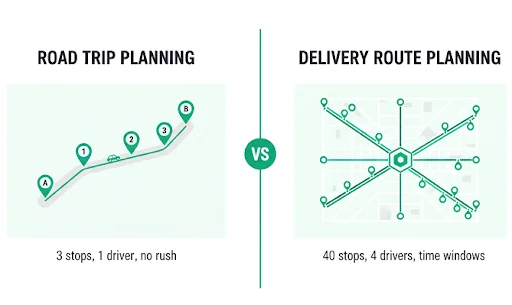
Most route planners are built for road trips. Point A to point B with a few stops in between. That is not delivery.
Delivery route planning means handling 30, 50, or 100 stops at once. It means splitting those stops across multiple drivers. It means your routes start at a kitchen or warehouse and might end somewhere completely different. It means customers have time windows, and a 2 PM drop that shows up at 3:30 PM costs you a review, a refund, or a customer.
If your tool cannot handle all of that, you are still doing half the work manually.
What a Delivery-Ready Route Planner Actually Does
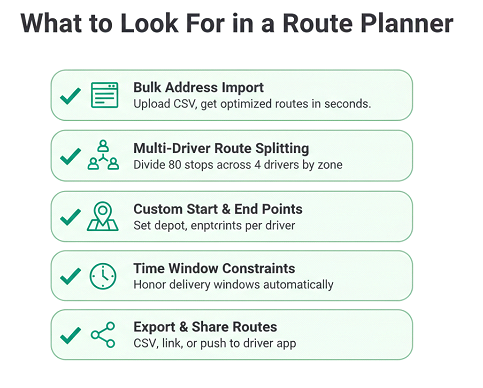
Not all route optimization is equal. Here is the checklist that separates tools built for delivery teams from everything else:
Handles bulk address import. You should be able to upload a CSV or Excel file with all your stops and get optimized routes back in seconds. If you are copy-pasting addresses one at a time, the tool is wasting your time.
Splits stops across drivers. You do not just need one optimized route. You need to divide 80 stops across four drivers, grouped by zone, each with their own optimized sequence. A good route planner does this in one step instead of forcing you to manually sort who gets what.
Lets you set start and end points. Your driver starts at the depot. Maybe they end there too, or maybe they end at a second location Multi-Stop Delivery Routes. If the tool assumes every route is a round trip, it does not understand delivery.
Respects time windows. Some drops have to happen between noon and one. Others are flexible. Route optimization should reorder stops automatically while honoring those constraints — not force you to choose between an efficient route and keeping your promises.
Exports and shares easily. Once routes are built, you need to get them to your drivers fast. Download as CSV, share a link, or push to a driver app. If the only option is a screenshot of a map, that is a problem.
Five Habits That Make Good Routes Great
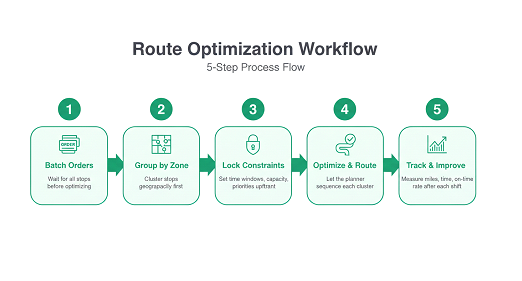
Even with the right tool, a few habits separate teams that save 15 percent on fuel from teams that save 30 percent.
Batch before you optimize. Do not plan routes as orders trickle in. Wait until you have all the stops for a delivery window, then optimize the full batch. Partial information produces partial results.
Group by zone first, then optimize. Before splitting stops across drivers, cluster them geographically. Then let a route planner optimize each cluster. This prevents two drivers from crossing paths on the same street.
Lock in your constraints up front. Time windows, priority deliveries, vehicle capacity — set these before you generate routes. Adjusting after the fact means re-doing the whole thing.
Run the numbers after each shift. Track total miles, total time, and on-time rate. Patterns show up fast. Maybe your Tuesday afternoon routes always run long because of school traffic. Shift those stops earlier and the problem disappears Multi-Stop Delivery Routes.
Start at one delivery window. You do not need to change everything at once. Pick your busiest window, run it through a multi stop route planner, and compare to what you would have done by hand. The gap is usually obvious.
Why This Matters More Than You Think
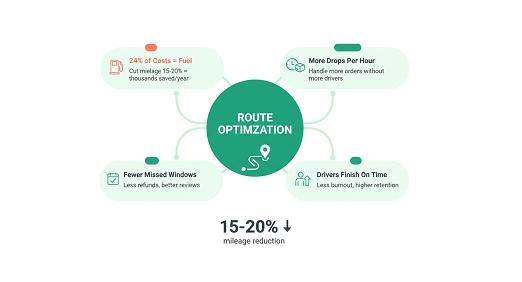
Fuel is roughly 24 percent of operating costs for delivery businesses. Cut your total mileage by 15 to 20 percent and that is thousands of dollars a year for even a small team.
But the real win is not just fuel. It is drivers finishing on time instead of burning out. It is fewer missed windows and fewer angry calls. It is being able to take on more orders without hiring more drivers.
Delivery route planning is not a nice-to-have anymore. If your competitors are optimizing and you are not, they are doing more drops per hour at a lower cost. That gap compounds every single day.


There is a moment in every homebuyers search when everything feels exciting and full of possibility, scrolling through listings, imagining different spaces, picturing what life could look like in each one. It often starts simply, a few clicks here, a couple of inspections there, and the sense that finding the right place is just a matter of time. Somewhere along the way, though, things begin to shift. Questions come up, uncertainty creeps in, and decisions start to feel heavier than expected. That is usually when the idea of working with a buyers advocate byron bay begins to make a lot more sense than trying to manage everything alone.
The Illusion of Simplicity
At first glance, buying a home seems like a process anyone can handle with enough research. Property websites are easy to navigate, price estimates are everywhere, and there is no shortage of advice floating around. It gives the impression that everything needed is already within reach.
What tends to get overlooked is how much of the real work happens behind the scenes. Pricing is rarely as straightforward as it appears online. Comparable sales can be misleading, market conditions shift quickly, and sellers often have strategies that are not obvious at first glance. Without experience, homebuyers is easy to misread the situation and make decisions based on incomplete information.
That sense of control can fade quickly once negotiations begin or when multiple buyers show interest in the same property. What looked simple suddenly becomes layered, fast-moving, and a little unpredictable.
Hidden Costs That Quietly Add Up
One of the most common surprises for homebuyers is how many costs exist beyond the purchase price. Some are expected, like legal fees or inspections, but others are less obvious until it is too late to avoid them.
There can be structural issues that only show up during detailed inspections, or future maintenance costs that were not immediately visible. In competitive situations, buyers sometimes feel pressure to stretch beyond their comfort zone, only to realize later that the financial impact is greater than anticipated.
A trained eye can spot warning signs early. More importantly, homebuyers can help separate a good opportunity from a risky one. That kind of clarity is difficult to achieve when emotions are involved and timelines are tight.
Access Changes Everything
Not every property is equally visible to every buyer. Some homes are sold before they ever reach major platforms, while others are quietly circulated within professional networks. Relying only on public listings can mean missing out on some of the best opportunities available.
Having access to a broader pool of properties changes the entire experience. Instead of competing over what everyone else can see, buyers can explore options that are less crowded and sometimes better suited to their needs.
This is where connections and industry relationships start to matter. It is not just about finding a property, it is about finding the right one before it becomes everyone’s target.
Negotiation Is Not Just About Price
There is a common belief that negotiation is simply about offering less and hoping for the best outcome. In reality, homebuyers is a layered process that involves timing, presentation, and understanding the seller’s position.
A well-structured offer can be more attractive than a higher one if it aligns better with the seller’s priorities. Terms, conditions, and flexibility often play a role that is just as important as the number itself.
Without experience, it is easy to focus only on price and miss the bigger picture. That can lead to missed opportunities or agreements that look good on paper but do not serve long-term interests.
Time Has a Cost Too
Searching for a homebuyers can quietly take over daily life. Weekends fill up with inspections, evenings are spent comparing listings, and there is always the feeling that something better might appear tomorrow.
That kind of constant attention is difficult to sustain, especially when balancing work, family, and other responsibilities. Over time, fatigue can set in, and decisions may become rushed just to bring the process to an end.
Having someone manage the search, filter options, and coordinate viewings can make a noticeable difference. It turns a scattered process into something more structured and manageable, allowing buyers to focus on the decisions that truly matter.
Emotional Decisions Are Expensive
A home is not just a financial investment, it is a personal one. That emotional connection can be powerful, and sometimes it can lead to choices that are not entirely rational.
Falling in love with a property can make it harder to walk away, even when there are clear reasons to pause. On the other hand, hesitation can cause buyers to miss out on genuinely good opportunities.
Balancing emotion with logic is one of the more challenging parts of the process. It helps to have someone involved who can provide a steady, objective perspective when things start to feel uncertain.
The Value of Knowing the Market
Markets are not static. What was true a few months ago may not apply today. Prices shift, demand fluctuates, and local factors can influence outcomes in ways that are not immediately obvious.
Understanding these patterns takes time and consistent exposure. It is not something that can be fully grasped through occasional research. Without that insight, it becomes harder to judge whether a property is fairly priced or whether there is room to negotiate.
Accurate knowledge creates confidence. It allows buyers to move forward without second-guessing every step, which can be just as valuable as securing a good deal.
Avoiding Regret After the Purchase
The moment the keys are handed over is often filled with relief and excitement. It marks the end of a long journey and the beginning of something new. Yet, for some buyers, that feeling is followed by questions.
Was the price right, could a better option have been found, were there details that should have been considered more carefully?
These thoughts tend to surface when decisions are made under pressure or without enough clarity. Taking the time to approach the process with the right support can reduce the chances of those doubts appearing later.
A Smarter Way Forward
Choosing not to go through the process alone does not mean giving up control. In many ways, it is the opposite. It means having access to better information, clearer guidance, and a strategy that is built around personal goals.
The journey to finding the right home does not need to feel overwhelming or uncertain. With the right approach, it becomes more focused, more efficient, and far less stressful.
For those who have already spent time searching without results, or for those just beginning to explore the market, the difference often comes down to the kind of support involved. Having the right expertise on hand can turn a complicated process into something far more manageable, and ultimately, far more successful.

Ellis Segura: Celebrating a Life of Love, Legacy, and Lasting Memories

Paul Werdel: From Storytelling Passion to Leadership in Digital Journalism

Jeroen Dik: Blending Racing Success with Legendary Tuning Mastery

How Integrating Interfax Faxing Software Streamlines Business Communications?

Agency Owners: Key Considerations When Evaluating Erp Vendors
-

 General6 months ago
Felixing: A Philosophy of Turning Simple Ideas into Wonders
-

 Health6 months ago
Lufanest: Effective Local Anesthesia with Fewer Risks
-

 General7 months ago
bardoek: The Artistic Heritage Inspiring Modern Creative Trends
-

 Entertainment5 months ago
هنتاوي.com: Your Gateway to Arabic Anime Content
-

 General5 months ago
Discover Anonib AZN: An Anonymous Asian Forum
-

 Fashion7 months ago
fashionisk .com – Your Ultimate Guide to Trendy, Smart Fashion
-

 Lifestyle7 months ago
Mariano Iduba: A Visionary Leader in Global Digital Growth
-

 Fashion7 months ago
Casîo: Explore Legacy, G-SHOCK Watches, Keyboards, and More